What Craniospinal Irradiation Means for Care
When a treatment plan includes craniospinal irradiation, patients and families are often hearing a great deal of unfamiliar information at once. This form of radiation therapy is more extensive than treatment directed at one tumor site, and it is recommended only in specific clinical circumstances. Understanding why it has been advised, what planning involves, and how side effects are monitored can bring needed clarity during a stressful time.
What is craniospinal irradiation?
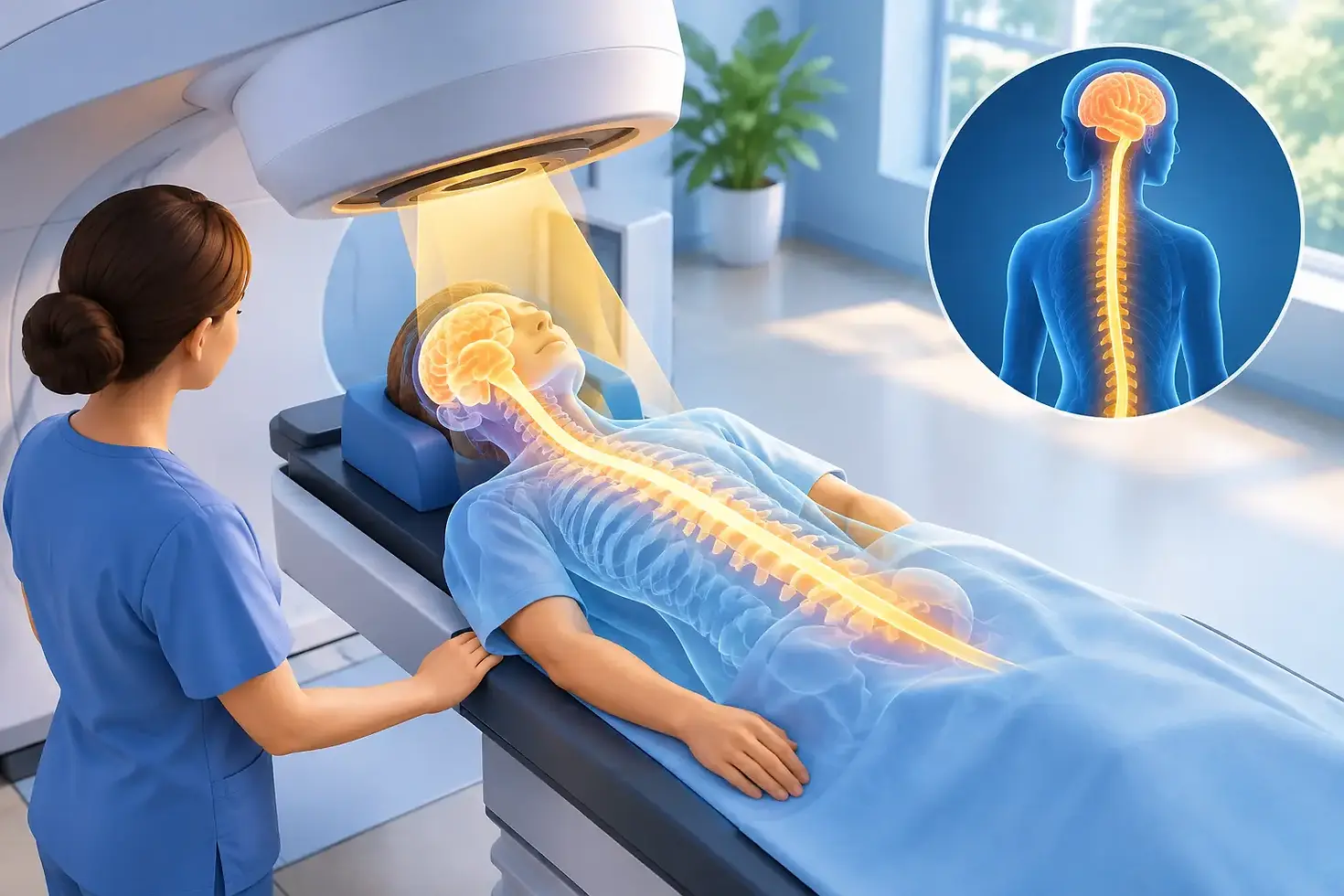
Craniospinal irradiation, often abbreviated as CSI, is radiation treatment to the brain and the spinal canal. The goal is to treat the cerebrospinal fluid pathways that surround the brain and spinal cord. Because certain cancer cells can travel through this fluid, treatment may need to cover the full pathway rather than a single visible tumor.
CSI is used most commonly for tumors that begin in or can spread through the central nervous system. Medulloblastoma is a well-known example, particularly in children, although some adults require this treatment as well. Depending on the diagnosis and disease pattern, it may also be considered for selected germ cell tumors, ependymoma, or cancer involving the leptomeninges, the delicate membranes around the brain and spinal cord.
This is not a treatment chosen simply because cancer is near the brain or spine. The recommendation depends on the tumor type, imaging findings, pathology results, prior surgery, whether disease is present in spinal fluid, and the anticipated benefit of treating potential microscopic cells. These details make specialist review especially valuable.
Why the treatment area is so large
Cancer care is increasingly precise, but precision does not always mean treating the smallest possible area. In craniospinal irradiation, precision means accurately treating the areas at risk while reducing radiation exposure to normal tissue as much as possible.
A tumor can shed cells into cerebrospinal fluid even when scans do not show a deposit at every location. CSI addresses that possibility across the brain and spinal canal. In many situations, treatment is then followed by a boost, which is extra radiation focused on the original tumor site or another area of known disease.
The balance is carefully individualized. A clinician considers whether the likely benefit in disease control justifies the short- and long-term effects of treating this larger region. Age, overall health, previous therapies, extent of disease, and personal goals all matter. For an adult with a different type of cancer that has spread to the brain or spine, whole-brain radiation, focused stereotactic radiation, surgery, systemic therapy, or supportive care may be more appropriate than CSI. The diagnosis, not the name of the treatment alone, should guide the decision.
How craniospinal irradiation is planned
Treatment planning begins well before the first radiation session. Patients undergo a simulation appointment, usually including a CT scan in the treatment position. A custom mask helps keep the head still and reproducible from day to day. Depending on the technique and body position, additional positioning supports may be used for the shoulders, torso, or legs.
The radiation oncology team combines simulation images with MRI scans and other relevant studies. The radiation oncologist outlines the treatment targets and nearby organs that need protection, such as the eyes, thyroid, lungs, heart, kidneys, bowel, and bone marrow. Medical physicists and dosimetrists then create and test a plan that delivers the prescribed dose as accurately as possible.
Modern techniques can improve dose distribution compared with older approaches. Photon-based methods may include highly conformal planning and image guidance. Proton therapy may be considered at centers that offer it, particularly for some children and younger adults, because protons can reduce radiation beyond the target area. That potential advantage is meaningful, but proton therapy is not automatically the best choice for every patient. Access, insurance coverage, anatomy, treatment urgency, and the expected clinical benefit all deserve discussion.
Before treatment starts, the team performs quality checks to confirm that the plan can be delivered safely. During the course of therapy, imaging is used to verify positioning. This technical work is largely invisible to patients, but it is central to safe, accurate care.
What treatment days are like
CSI is generally given in small daily doses, Monday through Friday, over several weeks. The exact number of sessions varies according to the diagnosis, risk group, prior treatment, and whether a boost is planned.
The radiation itself is painless. A session may last 15 to 30 minutes, although time in the treatment room can vary with setup and imaging. Patients need to lie still, and the care team watches and communicates from outside the room. For young children or adults who cannot remain still comfortably, anesthesia or additional support may be arranged.
It is common to feel anxious before the first session. Asking to see the treatment room, understand the positioning devices, or hear what the machine sounds like can make the experience more predictable. Family members and caregivers can also help by keeping a simple record of appointments, symptoms, medications, and questions for the weekly review.
Side effects: what the team watches closely
Side effects differ from person to person. They are influenced by the radiation dose and technique, the use of chemotherapy, the patient’s age and baseline health, and which areas receive additional focused treatment.
During or soon after CSI, fatigue is common and can build gradually. Hair loss on the scalp is expected when the brain is treated. Some patients develop nausea, vomiting, headache, skin irritation, changes in appetite, or temporary throat discomfort. Radiation to the spinal canal can affect bone marrow, where blood cells are made, so blood counts may need regular monitoring. Low blood counts can contribute to tiredness, infection risk, or bruising and may affect the timing of chemotherapy.
Supportive care is not an afterthought. Anti-nausea medicines, nutrition guidance, hydration support, skin-care advice, and blood tests are part of a well-managed treatment course. Patients should report symptoms early rather than trying to endure them alone. Fever, uncontrolled vomiting, new weakness, confusion, severe headache, significant bleeding, or sudden changes in bladder or bowel function require prompt medical attention.
Long-term effects require equally thoughtful follow-up. Depending on age and treatment details, these can include effects on hormone function, thyroid health, fertility, hearing, memory, concentration, growth in children, bone health, heart or lung function, and the small risk of a future second cancer. Not every patient experiences these complications, and some risks can be reduced through modern planning. Still, honest discussion before treatment is essential.
Fertility preservation should be raised before treatment begins when relevant. This conversation may involve sperm banking, egg or embryo freezing, ovarian tissue preservation, or referral to a fertility specialist. The best option depends on time available, age, medical circumstances, and personal priorities.
Questions that support informed decisions
A clear consultation should leave room for questions, not just instructions. Patients may wish to ask why CSI is recommended in their particular case, what alternatives exist, how the treatment is being tailored, whether proton therapy is relevant, and what the expected short- and long-term effects are.
It can also help to ask how treatment will fit with surgery, chemotherapy, rehabilitation, school, work, or caregiving responsibilities. For patients seeking a second opinion, bringing pathology reports, operative notes, MRI and CT images, previous radiation records, and a current medication list allows the reviewing specialist to assess the plan in context.
Support beyond the radiation room
Craniospinal irradiation can be demanding, but patients should not have to manage its medical and emotional effects in isolation. Radiation oncologists work alongside medical oncologists, neurosurgeons, nurses, physicists, dietitians, rehabilitation professionals, social workers, and primary care clinicians. The specific team will vary, but coordinated communication matters.
For families, practical support can be as valuable as medical knowledge: arranging transport, preparing easy meals, protecting time for rest, and helping the patient communicate symptoms accurately. For the patient, it is reasonable to ask for explanations in plain language and to revisit a decision when new information arises. A carefully planned course of treatment should provide not only technical precision, but also a clear path for support at each stage.


Comments